
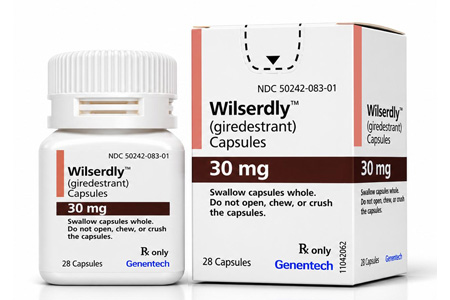
Genentech, a member of the Roche Group announced that the U.S. Food and Drug Administration (FDA) (USA) U.S.A.) approved WILSERDLYTM (giredestrant) as a single agent for the adjuvant treatment of adult patients with stage I, II and III breast cancer with positive estrogen receptors (ERs) and negative human epidermal growth factor receptor (HER2) receptor 2, with a risk of intermediate-to-high recurrence.
“This FDA approval makes WILSERDLY the first approved SERD drug for early-stage ER-positive breast cancer, having demonstrated superior efficacy against tamoxifen and aromatase inhibitors, which have defined the standard of care for decades,” said Levi Garraway, M.D., Ph.D., chief medical officer and head of Global Product Development. “By addressing a critical need for early-stage disease, where the chance of cure is higher, WILSERDLY has the potential to establish a new and important standard of care for patients and physicians.”
This approval is supported by the iconic phase III leadERA study, in which adjuvant treatment with WILSERDLY reduced the risk of recurrence of invasive disease or death by 30% compared to standard endocrine therapy, which included tamoxifen and aromatase inhibitors (risk index [HR] stratified = 0.70; confidence interval [CI] of 95% Overall survival data were immature at the time of this analysis, but a clear positive trend was observed. Patients treated with WILSERDLY demonstrated lower overall rates of treatment discontinuation due to adverse events compared to standard endocrine options (5.3% vs. 8.2%).
“For clinicians treating early-stage ER-positive breast cancer, the goal is not only to treat the disease we see today, but to reduce the risk of it coming back in the coming years,” said Aditya Bardia, M.D., M.P.H., a global principal investigator for the leading clinical trial Breast Cancer, a professor of medicine at the David Geffen School of Medicine at the University of California, Los Angeles (UCLA) “In the lideRA study, patients treated with giredestrant had a lower risk of invasive disease recurrence and fewer treatment interruptions due to adverse events compared to standard endocrine therapy, representing a significant clinical advance for breast cancer patients.”
This follows the recent FDA approval of WILSERDLY in combination with everolimus for the treatment of adult patients with locally advanced or metastatic breast cancer, ER-positive, HER2-negative and with mutation in ESR1, as detected by an FDA-authorized test, whose disease has recurred during or after completing endocrine-based adjuvant therapy, or has progressed after at least one endocrine-type regimen in the environment. WILSERDLY is now becoming the first and only selective estrogen receptor degrader (SERD) approved for early-stage, advanced-stage breast cancer.
“Our ambition is for WILSERDLY to become a fundamental endocrine therapy for ER-positive breast cancer, both early and advanced stage, and these two approvals represent an important step in that direction,” said Teresa Graham, executive director of Roche Pharmaceuticals. “We will continue to invest in the broad development of WILSERDLY and explore its potential at different stages of the disease and in new treatment combinations, with the ultimate goal of improving outcomes for more people affected by breast cancer.”
“Progress in breast cancer treatment is measured by advances that give patients and their families more valuable time. Even with all the progress we’ve made, the need for new treatment options remains critical,” said Amber Guild, president and CEO of Susan G. Komen. “We are excited about what this new treatment option can offer patients, so we must continue to push the boundaries of science until no one has to fear a breast cancer diagnosis.”
Genentech’s extensive and robust WILSERDLY clinical development program encompasses different treatment environments and therapy lines, reflecting our commitment to delivering innovative medicines to as many people with HR-positive breast cancer as possible. Other regulatory applications and development activities are currently underway in markets outside the U.S. U.S.
Availability and access in the US. U.S.
WILSERDLY is expected to be available in the US. U.S. in the next few days. As part of our commitment to helping patients overcome potential barriers to access to treatment, Genentech offers support through Genentech’s Access Solutions, including analyzing health insurance coverage, understanding reimbursement options, and identifying potential financial assistance options. Eligible patients with commercial insurance can pay as little as $0 for the drug WILSERDLY through the Genentech co-payment assistance program. For patients experiencing documented health insurance-related delays, the WILSERDLY Bridge Program may offer medications provided by Genentech temporarily and free of charge to help eligible patients start treatment while the coverage is resolved. For more information, call 866-4ACCESS/866-422-2377 or visit https://www.genentech-pro.com.
About the study leadERA Breast Cancer
leadERA Breast Cancer [NCT04961996] is a randomized, open-label, multicenter phase III study that assesses the efficacy and safety of WILSERDLYTM (giredestrant) as an adjuvant monotherapy against standard endocrine therapy in people with stage I-III breast cancer with estrogen receptor positive and receptor 2 for negative, intermediate-risk or high-risk human epidermal growth factor. More than 4,100 patients were enrolled in the study.
The primary endpoint is invasive disease-free survival (iDFS), excluding unrelated cancers in other organs (second primary cancers other than breast cancer). Key secondary endpoints include: overall survival, iDFS with second primary cancers other than breast cancer, disease-free survival, and safety.
About WILSERDLYTM (giredestrant)
WILSERDLY is a powerful, and new-generation, oral, selective estrogen receptor degrader (SERD) and a complete antagonist designed to achieve a deep and sustained inhibition of estrogen receptor (ER) signaling. WILSERDLY is designed to prevent estrogen from binding to the ER, which triggers the breakdown of the ER protein (process known as degradation) and stops or slows the growth of cancer cells.
Preclinical data have demonstrated improved clinical potency over other oral SERDs, which could allow treatment with one of the lowest doses among oral SERDs.
About hormone receptor (HR) positive breast cancer
Globally, the impact of breast cancer continues to increase, with 2.3 million women diagnosed and 670,000 dying from the disease each year. Breast cancer remains the leading cause of cancer-related death among women and the second most common type of cancer.
HR-positive and receptor-positive breast cancer 2 of the negative human epidermal growth factor accounts for approximately 70% of breast cancer cases and more than 90% is diagnosed at an early stage. One defining characteristic of HR-positive breast cancer is that your tumor cells have receptors that bind to hormones like estrogen, which can contribute to tumor growth.
Despite advances in treatment, HR-positive breast cancer remains particularly difficult to treat due to its biological complexity. Patients often face the risk of disease progression, side effects of treatment, and resistance to endocrine therapy. There is an urgent need for more effective treatments that can slow clinical progression and reduce the burden of treatment on people’s lives.
What is WILSERDLY?
WILSERDLY is a prescription drug used:
on its own to treat adults with estrogen receptor-positive (ER+) breast cancer, negative human epidermal growth factor receptor (HER2-) in early stages (stage I, II, III) and with a risk of intermediate- and high-reappearance.
in combination with the drug everolimus to treat adult patients who have estrogen receptor-positive (ER+) breast cancer, negative human epidermal growth factor receptor 2 (HER2-) and a certain mutation in the estrogen receptor gene (HER2)ESR1) and that has spread to nearby tissues or lymph nodes (locally advanced) or to other parts of the body (metastatic) whose cancer:
has reappeared during or after the end of the hormonal (endocrine) treatment given after surgery (adjuvant therapy)
or
It has worsened after at least one type of endocrine treatment for metastatic cancer.
When WILSERDLY is used in combination with everolimus, your health care provider will test you to make sure WILSERDLY is right for you.
It is unknown whether WILSERDLY is safe and effective in children.
Important: WILSERDLY is used with everolimus. You should also read the Patient Information that comes with everolimus.
What are the possible side effects of WILSERDLY?
WILSERDLY can cause serious side effects, including:
Slow heart rate (bradycardia). WILSERDLY may cause a decrease in heart rate. Your health care provider will monitor your heart rate more frequently if you have a history of slow heart rate or take certain heart medications. Tell your health care provider if you have any signs or symptoms of slow heart rate, including:
dizziness
stunning
fainting
lack of air
pain in the chest
tiredness
Side effects and abnormal results from the most frequent WILSERDLY blood tests alone include:
Muscle and joint pain
decrease in white blood cell counts
increased liver enzymes (aspartate aminotransferase [AST], alanine aminotransferase [ALT] and alkaline phosphatase [ALP])
sudden sensation of warmth and sweating (suffocation)
Increased triglyceride and cholesterol levels in the blood
tiredness
decrease in red blood cell count
Increased blood calcium levels
headache
decreases in blood calcium levels
Increased potassium levels in the blood
increased blood creatinine levels (renal function test)
nausea
decrease in blood sodium levels
slow heart rate
decreases in potassium levels in the blood
COVID-19
Side effects and abnormal results in the most frequent WILSERDLY blood tests in combination with everolimus include:
decrease in red blood cell count
decrease in white blood cell count
increased liver enzymes (aspartate aminotransferase [AST] and alanine aminotransferase [ALT])
Sores in the mouth (stomatitis)
decrease in platelet count
decreases in blood calcium levels
decreases in potassium levels in the blood
Skin rash
increased blood creatinine levels (renal function test)
tiredness
decrease in blood sodium levels
diarrhea
Muscle and joint pain
Pulmonary or respiratory problems
nausea
WILSERDLY can affect the fertility of men, as well as women who may become pregnant. If you are worried about this, talk to your health care provider.
These are not all possible side effects of WILSERDLY.
Before taking WILSERDLY, tell your health care provider about all of your medical conditions, including if:
has a slow heart rate (bradycardia)
She is pregnant or plans to get pregnant. WILSERDLY can harm your baby in pregnancy
Women who can become pregnant:
Your health care provider will have a pregnancy test before you start treatment with WILSERDLY.
Use effective non-hormonal contraception during treatment with WILSERDLY and for 2 weeks after the last dose of WILSERDLY. Talk to your health care provider about birth control that may be right for you.
If you take WILSERDLY in combination with everolimus, your health care provider will tell you how long you should use birth control.
Tell your health care provider right away if you become pregnant or think you may be pregnant during treatment with WILSERDLY.
Men with female partners who may become pregnant:
Use effective birth control during treatment with WILSERDLY and for 2 weeks after the last dose of WILSERDLY.
She's nursing or planning to breastfeed. It is not known whether WILSERDLY is transmitted to breast milk. NoNon-breastfeeding during treatment with WILSERDLY and for 2 weeks after the last dose of WILSERDLY. Talk to your health care provider about how best to feed your baby during this time.
It is intolerant to some sugars present in milk and dairy products. WILSERDLY capsules contain lactose monohydrate.
Tell your health care provider about all medications you use, including prescription and over-the-counter medications, vitamins, and herbal supplements. Taking WILSERDLY along with certain medications may affect the functioning of WILSERDLY and cause side effects.
What should I avoid while taking WILSERDLY?
Avoid eating grapefruit and drinking grapefruit juice during treatment with WILSERDLY. Grapefruit can increase the amount of WILSERDLY in your blood.
Talk to your health care provider to learn more about the benefits and risks of treatment with WILSERDLY.
You may report side effects to the FDA at 1-800-FDA-1088 or at www.fda.gov/medwatch. You may also report side effects to Genentech at 1-888-835-2555.
See Important Safety Information, as well as full Prescription Information and WILSERDLY Patient Information.
About Genentech in the field of breast cancer
Genentech has revolutionized the approach to breast cancer for over 30 years. From pioneering HER2+ cancer-based treatments to developing new approaches to fighting resistance in HR+ disease, our goal is to offer transformative therapies from early stages to advanced stages of the disease to help as many people living with breast cancer as possible. By collaborating across the cancer ecosystem, driving innovative scientific breakthroughs and applying advanced technologies, we are committed to achieving the best results and building a future in which people with cancer can thrive, despite their diagnosis.
For more information please visit http://www.gene.com.
